
- Search
A former bishopric on the banks of the river Asse, Senez is a village steeped in history, with a rich and well-preserved cultural heritage. As a stopover on the imperial road, Napoleon stopped off to visit the cathedral, now a listed monument.
It was a large agricultural estate, organized around an isolated church dedicated to Saint Pierre, that gave rise to the present-day commune. Today, it is the extreme southeastern tip of the Alpes de Haute Provence.
A belvedere overlooking the Asse valley at an altitude of 815 m, Saint-Lions has no coat of arms, as it only gained independence from the community of Barrême during the Directoire period. Today, it is a small village with a pastoral and agricultural vocation.
Situated at the confluence of the Asses de Clumanc, Moriez and Blieux, Saint-Jacques is known for its Barremian nummulites, fossils whose presence is promoted by the Réserve géologique de Haute Provence through a special site.
Deprived of part of its agricultural land when the Castillon dam was built, the village of Saint Julien du Verdon now sits on a balcony above the lake, offering superb 360° panoramic views and hosting a water sports center.
Situated on the shores of Lac de Castillon, Saint-André- les-Alpes offers a multitude of outdoor activities, including hang-gliding, for which it is a renowned site. In the village, the cloth mill trail is a testament to its industrial heritage.
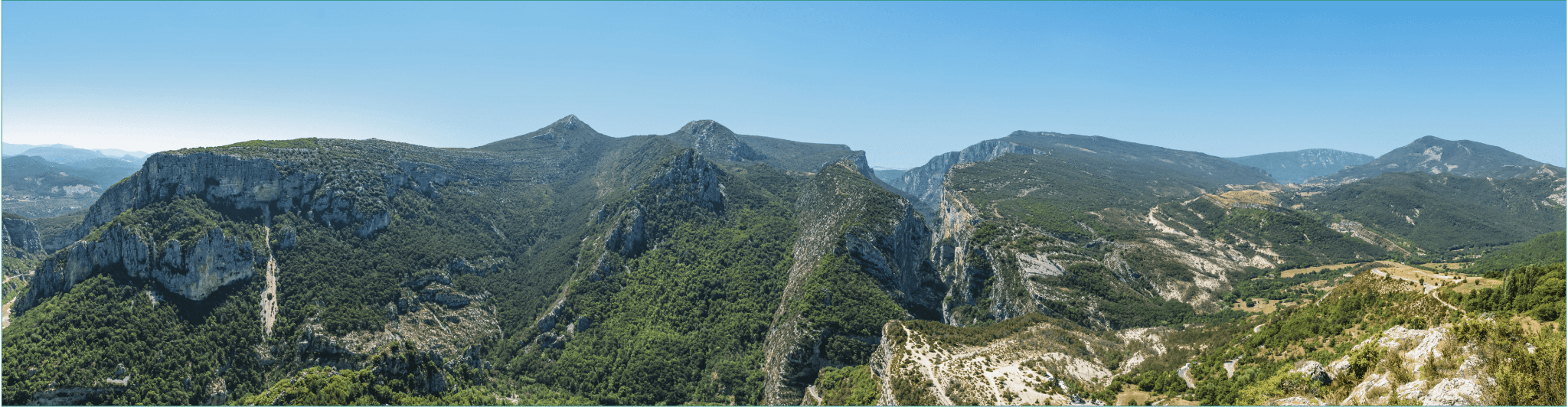
A veritable hilltop village, Rougon overlooks the Samson couloir and Point Sublime from its rocky outcrop, offering one of the finest views of the Verdon Canyon.
Peyroules, more than a village, is in fact a group of four hamlets spread across a plateau between valley and rocky outcrops: La Rivière, the main hamlet occupying the center of the commune, La Bâtie to the west, La Foux to the east and Mousteiret to the south.
Established along the road linking Digne to Saint André, Moriez was a thriving business in the 19th and 20th centuries, with the manufacture of linen and the distillation of lavender. Its name comes from the Latin Muria, meaning salt, in connection with its salt well,
Situated on the banks of the Vaïre river, Le Fugeret spreads out like a fan, but the commune extends well beyond the central village, into the Annot sandstone massif, and is made up of numerous hamlets, including Bontès, Argenton and Chabrières.